Thursday, May 19, 2011

Doctor Faustus Lights the Lights


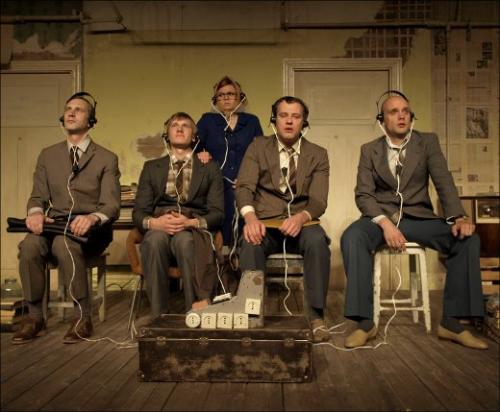
"Doctor Faustus Lights the Lights" has the hand of its creator, Gerturde Stein, all over it. The title alone sums up her two obsessions: power and repetitive language. On the one hand there is the doctor who bargains dangerously with Mephisto, not, in Stein's retelling of the legend, for the love of Marguerite, but to master electric light. On the other is the kind of sing-songy word play that made the self-proclaimed mother of Modernism's reputation as a different sort of "illuminée".

Director Ludovic Lagarde confronts both features of her work in his version of Stein's opera libretto (1938) of the Faust legend. The terrain is well-traveled; even if Stein's work never found the audience she hoped for in her lifetime, her Faustus remake has tempted theater visionaries the Wooster Group, Richard Foreman and Robert Wilson. Where these others explored rather more her ontological theories regarding consciousness or their own theater aesthetic, Lagarde's production concentrates on her seemingly irrepressible repetition of ordinary words and phrases, what she called "insistencies", and shows that if Stein were alive today, she'd finally find fame as a pop music lyricist.

The show is indeed more concert than play, with a set that looks like it came from La Cigale down the road instead of the Bouffes du Nord: a raised backstage with keyboards and drums, center-front solo mike, neons, strobes... The lights come up on Faustus in a Mick Jagger pose and Mephisto excels at Keith Richards-style jumps and leaps across the stage. Stein challenged herself in her libretto to write a recognizable narrative but the audience is soon wondering who exactly are the strange pairs that join them through the smoke swirls and blue and yellow flashes. First, Boy and Dog, here a British schoolboy with a Nintendo-generated companion, followed by the always popular Marguerite Ida/Helena Annabel, who is herself the very embodiment of one of Stein's insistencies.

As always with Stein however, content takes a back seat to form, something Lagarde recognizes in his embracing of rock opera's cliches, which are like an open book in which Stein's phrases write their hypnotic and teasing musicality. Rodolph Burger's score throws rap and rock beats and pop's tonal angst at Stein's text, which embraces them all and loses 70 years of dust in the process. Playing further on the rock genre motifs, Lagarde's direction gives free reign to the sexual metaphors of Marguerite (etc.)'s predicament: stung (or bitten, the distinction is important) by a serpent between the legs.

Stein's theme of modern man's fear of progress is not obviously present among everything else happening on stage, except for the lonely figure of Dr. Faust and the glowing electric candles that form the stage's backdrop. Lagarde's attention falls more on the love story between Marguerite (etc.) and her Mr. Overseas Man. They are backed up by an eclectic cast of many contrasts and doublings, from the diminutive Annabelle Garcia as the sweet-faced Boy with troublingly confusing gender attributes, Stéfany Ganachaud's controlled and enigmatic Dog, whose canine features are made possible by a kind of futuristic Roller Ball costume, and Joan Cocho's monkey-like Mephisto in black t-shirt and jeans. Samuel Réhault's anomic Faust is the least interesting in his leather trenchcoat weighed down by Faust's arrogance.

As Marguerite Ida/Helena Annabel sang her name for the hundredth time at the performance I attended, audience members started to mildly panic, clutching at programs and watches: proof that, taken as literature, Stein's circular experiments can still challenge Cartesian order. Lagarde's production has the merit of hinting very strongly however that Stein's concerns are not so different than those of many a Grammy winner or MTV star: it's the music that matters.

To May 22, Tues-Sat, 9 pm, Sun, 4 pm, Théâtre des Bouffes du Nord, 37 bis, boulevard de la Chapelle, 10e, Métro La Chapelle, 14 euros-28 euros, tel: 01.46.07.34.50.

Photo Credit: Guillaume Gellert

Monday, May 16, 2011

Krystian Lupa's "Fin de partida"


The work of Samuel Beckett is a famous teaser. That the author of the theatrical conundrum of the 20th century, "Waiting for Godot", insisted that there are in his work "no symbols where none intended" (to paraphrase his novel "Watt"), has never much eased the public's anxiety of meaning when faced with his plays and fiction. If the Irish playwright's estate has worked tirelessly to reign in any and all over-zealous interpretations of his work, it still remains as difficult to refrain from dissecting Beckett as it is to resist gawking at an accident. "Endgame" which followed "Godot" by eight years, revisits many of the themes and situations of that defining play, such as dependency, suffering, inevitability, stasis - and no redemption from any of these - with a foursome of characters, here all physically impaired. "More inhuman than Godot" according to its creator, "Endgame" asks again how it is possible to live if there is no meaning to be found in what is commonly called life.

Regarded as one of the most important artists of contemporary European theater, Polish director Krystian Lupa comes to "Endgame" at the height of his work and influence, and his "interpretation" begs us consequently to sit up and take notice. Beckett's text imagines the blind and infirm Hamm, his servant Clov, and Hamm's maimed parents, Nell and Nagg, in unspecified grey and desolate surroundings on the edge of a sea. Some liberties Lupa takes include casting Clov as a woman (who asserts her femininity at the play's end) and replacing the trashcans Nell and Nagg are relegated to in the original, with glass-sided rolling boxes that are equal parts gerbil cage and casket. Hamm's house becomes an abandoned cement bunker, empty of furnishings save his wheelchair and a jarringly ornamental chandelier. The sea that Hamm and Clov listen to from the tiny windows has also pressed itself inside, in the form of a sand dune that partly obscures the doorway Clov enters and exits from, prompting him to swing in and out like a monkey (Clov has also been interpreted to mean "clown"). In addition, natural light reaches to the hard corners and dusty floors of their concrete shelter and does indeed bathe Hamm's face at the play's end. Could "hope" be far behind?

Certainly not, because, despite these deliberate choices, Lupa's production, with the Teatro de La Abadía of Madrid, excels at doing what Beckett claimed his work must: resist meaning. Enclosed within the faded green walls and menaced by the encroaching, inhospitable environment, the characters of this "Fin de Partida" exude a kind of absurdity that belies more typical representations of Beckett's existentialism as wholly pessimistic while never denying that their existence is no more than a farce. Susi Sanchez's Clov is a malicious teenager who throws biscuits at Nagg and laughs loudly at their daily frustrations, José Luis Gomez is a dryly cynical Hamm, a playground king in his dilapidated chair, black beret and glasses, while Nell and Nagg (Lola Cardón and Ramón Pons), all in white, farily radiate purity, one would dare say human attachment, into the mix. That is to say that, relieved of some of its darkest suggestions by Lupa's direction and set, Beckett's text gains in complexity. If death is obviously intimated by Nell and Nagg's coffin-like boxes, which slide into the wall as in a mausoleum, these also have an air of the glass caskets used in Catholic churches to enclose holy relics, while the whole set could be a gas chamber. Lupa opens the door to a variety of extrapolations. Similarly, Clov's final feminine elegance starkly contradicts the character's previously slouchy, juvenile delinquent air. "Nothing is funnier than unhappiness", says Nell. That mystery sums up Lupa's vision.

Contrasts may abound within Lupa's production but all the sunlight in the world can never change the blunt power of Beckett's language, even in translation. Since the opportunity presents itself currently, some interesting comparisons stand to be drawn with Alain Françon's "Fin de partie" featuring an all-star cast led by Jean-Quentin Châtelain and Serge Merlin, at the Théâtre de la Madeleine, until July 17.

"Fin de partida", in Spanish with French subtitles. May 13-18, Tues-Sat, 8:30 pm, Sun, 3:30 pm, Théâtre Nanterre-Amandiers, 7 avenue Pablo Picasso, Nanterre (92), RER A Nanterre-Préfecture, 12-25 euros, tel: 01.46.14.70.00. "Fin de partie", to July 17, Théâtre de la Madeleine, tel: 01.42.65.07.09, www.theatremadeleine.com.


Photo Credit: Teatro Abadía/Ros Ribas

Friday, May 6, 2011

Sounds of Silence


A number of reprises are in Paris in May and I'll be revisiting them here.

One of these, "The Sound of Silence", at the Théâtre de Chaillot for just three performances (previously at the MAC-Créteil in 2008), I first saw at the 2007 Europe Theater Prize in Thessaloniki, Greece. It was a creation by Alvis Hermanis, from Riga, Latvia, and a co-winner of the "New Realitites" Prize that year. In interviews at that festival, he revealed himself to be the odd child of Communist propaganda and Sixties idealism. Artistic Director of the New Riga Theater, he first spent 10 years focusing on classical productions, but these led him to make a self-described "radical shift", from adapting texts to creating a "theater of emotion" that explores private space and "real life".

The work that brought him international attention, "Long Life" (2003) is a case in point. The play delves into the everyday minutiae of five individuals sharing a post-Soviet-era communal apartment. Audiences, limited to a relative handful, entered the theater via the set, and were supplied opera glasses to dwell at leisure on the extraordinary jumble of objects, furniture, detritus and general miscellanea that the set contained, over the course of a three-hour, wordless performance.

The prequel to "Long Life" is "The Sound of Silence", which jumps back 40 years to a brief moment of Sixties-era bohemia, symbolized for Hermanis by Simon and Garfunkel's 1964 song of the almost same name, or at least insofar as it trickled into Soviet-controlled Latvia. Written in the aftermath of John F. Kennedy's assassination and pin-pointing a collective anomie, the folk hit came at the beginning of the Sixties political, cultural and sexual upheavals. These represented an even bigger danger in the Soviet bloc countries than they did on American college campuses, and Hermanis considers what life might have been like for his parents' generation, before the intensified Cold War hostilities of the early Eighties and the exacerbated economic and cultural stagnation that resulted across the USSR. Experimenting again with silent theater, in a 3hr15min attempt through music and gestures but no dialogue, to take the pulse of that fleeting moment, Hermanis seeks to tap into the era's utopianism to deliver a more "human dimension" to the theater act and our experience of it.

Hermanis is gaining increasing attention throughout Europe. A recent collaboration with theaters in Naples and Bologna under the auspices of the European Union's Prospero Project led to an Italian adaptation of Polish writer Jaroslaw Iwaszkiewicz's short story "The Wilko Girls" (1933), created in Modena in January 2010 and touring to European project member cities.

May 4-6, "The Sound of Silence", 8 pm, Théâtre national de Chaillot, 1 place du Trocadéro, 11-32 euros, tel: 01.53.65.30.00.

Wednesday, May 4, 2011

Persona.Marilyn


Many a man has fantasized about Marilyn Monroe, but when Kyrstian Lupa does, he is magnetized less by her blonde bombshell physique than by the icon she became, and why. "Persona. Marilyn" is the second work in the Polish director's trilogy exploring larger-than-life 20th century personalities. Between Andy Warhol ("Factory2", at Théâtre de la Colline earlier this season) and Simone de Beauvoir ("Le Corps de Simone"), Lupa's Marilyn is the heir of the former's embracing of market culture and the antithesis of the latter's intellectual asceticism.

A pin-up more than a flesh-and-blood woman, yet inherently carnal in all her representations, the former Norma Jean Baker never seemed in her lifetime to have much control over the forces that created her, marketed her, married her and buried her. Two highly public marriages and divorces, a messy emotional tailspin, and the never elucidated circumstances of her premature death were more than enough, after her sex-symbol superstardom, to secure her legend. Lupa picks up the threads of Monroe's story in the final days of her life, long after her raw talent had been confused by drugs, alcohol and, in Lupa's piece, the nefarious influences and competing interests of her acting coach, Paula Strasberg (wife of Lee Strasberg), and her analyst, Dr. Ralph Greenson.

If the real Marilyn lived life at full speed for a brief moment, Lupa slows the action down to a near standstill, placing his character in an abandoned film studio: a much needed retreat from the public eye but where she is also visited, one might even say preyed upon, by her various handlers and lovers. At the same time, he uses the contemporary tools of iconography, video and photography, to make clear that any revelations are precisely calculated: if she didn't control the machine that created her, she certainly assumed the image it projected of her . Actress Sandra Korzeniak is riveting as Marilyn, making love instinctively to the cameras with the star's particular combination of emotional fragility and overt sexuality. Hardly a moment Korzeniak spends on stage is not recorded or observed, and her Marilyn both needs and teases the public's gaze. Lupa's preoccupations and references turn on the nature of performance - his actors' and Marilyn's, on screen and in real life - more so than on any biographical artifacts or setting details (the characters drink from plastic water bottles and carry computer bags, circa 1962). He explores the theme from a variety of angles, including a play-within-a-play, as Marilyn rehearses again and again a scene from The Brothers Karamazov in which she tellingly plays the beautiful temptress Grushenka.

Lupa was winner of the Europe Theater Prize in 2009, in recognition of his intense direction of actors and painstaking construction of characters, both clearly on view in this show. He offers with "Persona. Marilyn" a slowly hypnotic reflection on la fabrique de l'image and the cult of the pop star, two features of contemporary society that may have begun with Marilyn but that have far surpassed anything she ever knew and which we are not likely to rid ourselves of any time soon.

In Polish with French subtitles. To May 7, 8:30 pm, Théâtre Nanterre-Amandiers, RER A Nanterre-Préfecture + navette, tel: 01.44.14.70.00.

Photo credit: D.R.

Wednesday, April 20, 2011

Some Traces of Katie Mitchell: Europe Theater Prize (III)


Director Katie Mitchell was awarded the 12th Europe "New Theatrical Realities" prize in St. Petersburg, Russia, last week (see previous posts regarding the event, below).

At 46 years old, Mitchell has lengthy directing credentials, first at Paine's Plow and the Royal Shakespeare Company, where she was an assistant director, and more recently as associate director at the Royal Court and currently at the National Theater. Mitchell trained extensively in Russia and Eastern Europe, in particular with Russian pedagogues Lev Dodin, of St. Petersburg's Maly Theater, and Anatoli Vassiliev of Moscow's Gitis school. In Britain, where she has been called one of the country's "most polarizing" directors, she is known for her almost obsessive background research, her strict application of Stanislavsky's system and a growing, complex body of multi-media work, as well as operas. An intimate collaborator of Britain's most famous contemporary playwright, Martin Crimp, she has directed two of his works, "Attempts on Her Life" and "The City", as well as his versions of others, such as "The Maids" and "The Seagull". That production earned her enormous criticism for her reworking of Chekov, but the experience has not prevented her from yet more ambitious adaptations, of Virginia Woolf's The Waves and Dostoevsky's The Idiot ("Some Trace of Her"). A children's show, from Dr. Seuss's The Cat in the Hat, is scheduled to come to Paris next December.

Extremely controlled and precise in her answers during a public interview at the conference, she provided, in the absence of an actual production, some insight into her concerns and methods. Extracts.


"I came here 22 years ago and looked at the work in this city with Lev Dodin and then in Moscow with Anatoli Vassiliev and in Georgia and Lithuania, in actually December '89 just after the Wall had fallen, and it was the most informative part of my... everything actually. It shaped everything that I did and do. I studied Lev Dodin's work and watched him train directors for three weeks in this city, so I was shaped by that visit and those international practitioners much more than I was shaped by anything in my own country."

"I suppose in the UK there is a preoccupation with language and speaking words, but there isn't such a preoccupation with constructing behavior and psychology, of which language is a small component. So in this country [Russia], at least, the legacy of the investigations of Stanislavsky, which were very rigorous investigations into how to represent life-like behavior on stage, that legacy created an amazingly sophisticated and complex methodology of acting and directing, with the emphasis on behavior and not on language. I think that was the thing I learned: the way that someone like Dodin or Vassiliev would scan every inch of the actor's body for the data, so that wherever the audience would look on the body they would get very thorough, precise data. And I've never really forgotten certain productions by Dodin or Vassiliev. They set the bar in my head for everything I make. And Pina Bausch, obviously."

"It's very strange to constantly have your influences a long way from you so you have to really work hard to hold them in your head. I think that's been the hard thing. Obviously, to fully understand Stanislavsky's late work, which is my interest and speciality, and to communicate it to actors in the rehearsal room, and then through the actors to the audience, has been 20 years of work. That's all I've been doing, really."

"I'm often sort of taking ideas about how to play an actor's intention or ideas about esthetics, color, the use of light, through several shows over several years. I think that to direct work is such a complex art because you have so many components: the writing, the acting, the lighting, the sound, the colors, the design. There are so many things that it's probably not possible to practice getting all of the strands of work without practicing over several shows. [...] If each production is life or death I get so frightened that I get paralyzed. But if a production is a production as well as a covert investigation of something, then I'm less paralyzed because I'm intellectually somehow free. [...] I don't think in individual productions. I think in arcs of work all the time."

"[As a director interpreting a play], I suppose you've got the surface dialogue of the text and you've got to analyze that, moment to moment: what every character is playing. That's one level. And then you take a mine shaft down deeper and you discover the ideas that consciously or unconsciously preoccupied the writer when they were writing the play, and these determine all the surface action. With all of Chekov's plays, one of the key ideas would be death or illness or family. Those were the ideas that were in his head, maybe not formulated as simplistically as that, but they were there. So those are things that I spend a lot of time trying to find: what are the key ideas that are driving the writer or driving the play at the same time as analyzing the surface, textual exchanges that are going on. That's why we're making theater, isn't it? We're making theater to communicate ideas. I don't think there is any other point to the act. The ideas have to seep through everything: the sound, the lighting, the acting. Everything. The reason that Chekov is so powerful is because the idea structure is so terrifying. Or Euripides: absolutely terrifying ideas. Every inch of the action that the audience sees has to be somehow in relationship to those ideas. And that's really hard. Its very easy to do the story of a play; that's really, really simple. But to do the story [of the] ideas is much harder; it requires a different form of articulation. But ideas aren't very popular, just like politics aren't very popular and morality isn't very popular and metaphysics aren't very popular and philosophy isn't very popular. There's a lot of interest in diversions and entertainment and escape and romanticizing behavior and making beautiful people. [...] My aim is only to honor the material. I'm incredibly rigorous and incredibly serious about what I do."

Photo credit: Luciano Rossetti © Phocus Agency

In Photos: 14th Europe Theater Prize (II)

A glimpse of the winners in the "New Realities" category of the 14th Europe Theater Prize held from April 12-17 in St. Petersburg, Russia (see article in previous post). Photo credits: Luciano Rossetti © Phocus Agency

Finnish director Kristian Smeds at a conference on his work


"Happiness" by Russian director Andrey Moguchiy at the Alexandrinsky Theater


Vesturport Theater's "Faust" and "Metamorphosis"


Teatro Meridional performing "Contos em Viagem - Cabo Verde" at the Komissarzhevskaya Theater


"The Theater" by Viliam Docolomansky's Farm in the Cave company

Diverse Realities: 14th Europe Theater Prize (I)


Built on flood-prone marshland and steely political will, St Petersburg was meant to be Russia's "window on Europe", at the Western-most edge of Peter the Great's empire. The organizers of the 14th Europe Theater Prize, awarded last week in the city equally famous for the October Revolution and the beginning of Communism, not improbably had in mind Peter's visionary project when they chose this former imperial capital to host the event. Their intentions would have been well placed: like no other edition, the 2011 Prize opened its own window on an eclectic spectrum of artists, most hailing from the confines of modern Europe and whose work the Prize legitimized in ways they never could have hoped for at home.

Created in 1986 under the auspices of the then European Community to recognize theater artists who are "promoting understanding and the exchange of knowledge between peoples", the Prize focused originally on superstar directors like Ariane Mnouchkine, Peter Brook, Georgio Strehler and Robert Wilson, before opening its boundaries to rising talents, in a section bis entitled "New Theatrical Realities". As Europe has grown and EU directives kept apace, the latter category is today bestowed on no less than five artists, so that, with the Grand Prize winner, at least six member states can be recognized every year. In addition to the hugely influential German director Peter Stein, whose decades of creation and innovation at Berlin’s Schaubühne made him a natural laureat of the Grand Prize, the New Realities section this year recognized directors Viliam Dočolomanský (Slovakia/Czech Republic), Katie Mitchell (UK), Andrey Moguchiy (Russia) and Kristian Smeds (Finland), as well as companies Teatro Meridional (Portugal) and Vesturport Theater (Iceland): an impressive cross-spectrum of "European realities", to be sure.

As a glimpse at how theater is dreamed, constructed and played out across the continent, this year's Prize event proved illuminating. Between the wordless anthropological studies led by the Teatro Meridional and the coolly high-tech narratives of Katie Mitchell, or between Andrey Moguchiy's animated cartoon characters and Kristian Smed's anarchic fury, or again between Vesturport's high-flying acrobatics and Dočolomanský's anti-globalization choreography, the possibilities are widely disparate and not likely to shrink any time soon. But if the quantity and imagination of these propositions seem limitless, their quality was invariably irregular, or in the case of Katie Mitchell, whose work was not shown at the festival, impossible to judge. A general if not always unwelcome sense of confusion reigned over the Prize's six days of conferences and performances.

What unites these artists, if coherence was on the agenda, is the physicality of their different approaches to story-telling and performance. Watching their work, it seemed already a truism to say that a shared belief that human beings are inherently theatrical as well as a consequent desire to translate human experience through the body rather than words, are probably the defining characteristics of new European theater. In any case, the Jury's choices made for an unusual showcase of generally unknown artists and their unfettered attempts at finding appropriate forms for their texts and ideas.

Of the work on offer among the New Realities, the most likely to book passage to France in a not too distant future comes from Mitchell and Vesturport. While the former was only briefly present in St. Petersburg, a meeting with her past and present collaborators, including the British playwright Martin Crimp, along with a public interview, provided a skeleton of Mitchell’s interests and methods, inspired from research and training in Russian and Eastern European traditions and Stanislavsky's system for actors. Firmly established on the British arts scene, as associate director of the National Theatre and a close collaborator of Crimp, Mitchell might have offered the most serious and evolved work of the New Realities laureates if she and the Prize organizers had found a way of showing any of her plays here.

So it had to be the Vesturport theater from Reykjavik who captured the most attention in St. Petersburg, with its casual hipster charm, good looks, team spirt and circus tumbling. The company presented two very different works, both adaptations of novels: Franz Kafka's "Metamorphosis" and Goethe's "Faust". The former was as controlled as the latter was wild, but both pieces manifested clear interpretative choices. "Metamorphosis" showed off actor/director Gisli Örn Gardarsson's gymnast training, in the role of Gregor Samsa's anti-heroic cockroach, but focused on family mores over existential crisis. Their “Faust” shrugged off Goethe’s philosophical and metaphysical considerations entirely, in favor of a love story between an aging actor and his young nurse, made contemporary by a rock opera esthetic and an original Nick Cave score. Physical theater and theater of ideas are frequent strangers but it might be hoped that Vesturport may develop stronger content to match its already massively appealing signature forms.

As the main reason for the Prize, Peter Stein was also strangely absent from the event, offering limited time with the public and, for the awards ceremony, a solo, one hour reading of "Faust" that showed off his frustration with the venue rather more than the doctor's dilemma or Marguerite's crimes. Stein's other work presented during the conference, an early 19th century comedy by Heinrich von Kleist, "The Broken Jug", performed under his direction by the Berliner Ensemble, was a perfect, even too clean example of Stein's work, better known for its uncompromising political vision. Along with Russian director Lev Dodin (winner of the 8th European Theater Prize), whose reprise of "The Three Sisters" at the Maly Theater was a reminder of the excellence of his company and the mastery of his art, at the forefront of contemporary Russian theater, Stein's presence at this year's edition starkly contrasted with the urgency of the New Realities' winners, even if they have much to learn from his vision of theater as essentially text-based.

The face of European theater is perhaps only harder to define after the 11th Europe Theater Prize but like the view through Peter the Great's "window", this edition showed a vast continent of artists waiting to be discovered.

Photo: Prize Ceremony at the A.S. Pushkin Russian State Academic Drama Theater, April 17, 2011. Credit: Luciano Rossetti © Phocus Agency